
The Enchanté Network
Rekindling Balance: Two-Spirit Leadership as a Guiding Light Toward Reconciliation
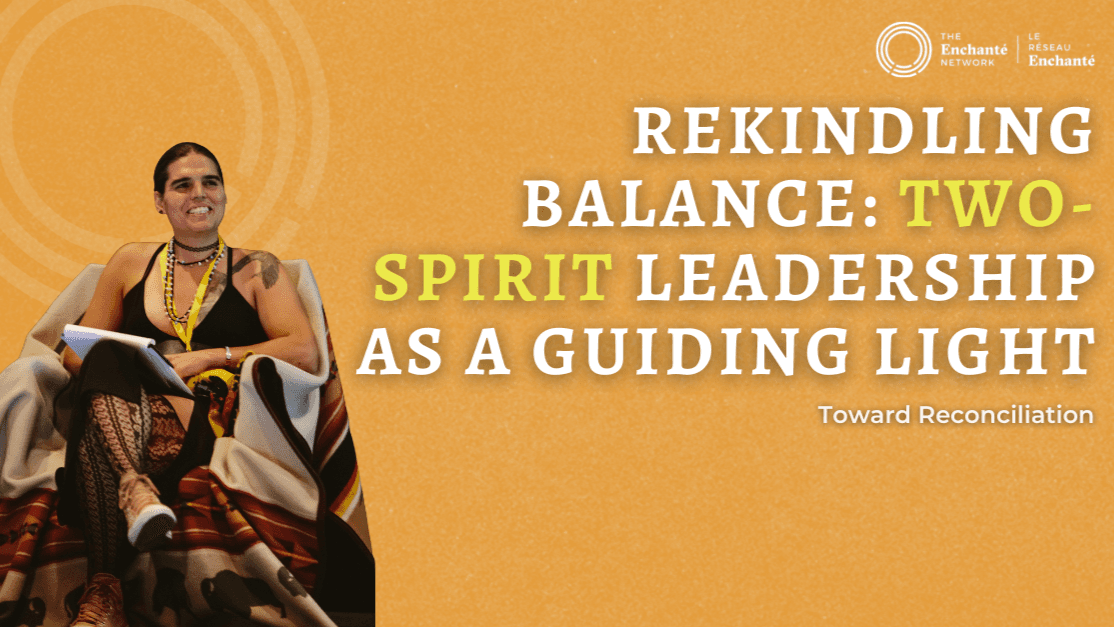
Imagine a drumbeat echoing through generations—a sound that refuses to be silenced, even by centuries of erasure. That is reconciliation’s call. September 30 is not a day of ceremony—it is a test of courage. The National Day for Truth and Reconciliation demands more than remembrance. It asks whether we will face the truths we inherited or retreat into symbolism. The stolen children, the extinguished languages, the fractured families—this is living grief, not distant history. Within that grief lies a path forward, carried by communities who have endured, resisted, and reimagined. Among them are Two-Spirit leaders, whose very existence defies colonial binaries and offers a vision of balance and renewal.
Two-Spirit Knowledge as Framework
For many Canadians, Two-Spirit remains misunderstood, too often reduced to shorthand for gender or sexuality. In reality, it is a worldview—a framework of balance between body and spirit, masculine and feminine, past and future. The term itself was adopted at the 1990 Third Annual Intertribal Native American, First Nations, Gay and Lesbian American Conference in Winnipeg to replace colonial language like “berdache”.
Historically, Two-Spirit people were healers, mediators, and knowledge keepers, deeply respected within many Indigenous nations. Their authority came not from dominance, but from the ability to bridge divides. Colonial systems, including residential schools, violently attempted to erase these roles, but resurgence today demonstrates their endurance.
Two-Spirit knowledge challenges shallow gestures. It teaches that healing is relational, justice is collective, and balance requires redistribution, reparation, and renewal.
Disrupting Comfortable Narratives
On September 30, comfort is the easiest trap. We wear orange, we post our statements, and we congratulate ourselves. Yet reconciliation is not comfort—it is disruption. Two-Spirit leaders embody that disruption in ways that are practical as well as symbolic. They break colonial gender systems. They challenge governance structures that exclude Indigenous voices. They dismantle the myth that reconciliation can happen without real shifts in power. Their leadership reminds us that reconciliation is not an event, but a redistribution of voice, resources, and authority.
Two-Spirit leadership pushes us beyond allyship into accountability. It asks: Who benefits from the current system? Who remains excluded? What would it mean to rebuild on Indigenous worldviews that honour balance and reciprocity instead of colonial foundations? It is an invitation, but also a demand—that institutions, governments, and communities move from statements to structural change, from performance to practice.
Stories of Continuity and Resistance
Scott Wabano uses fashion to reclaim Cree and Mushkegowuk aesthetics, declaring Indigenous beauty present and global. Kairyn Potts connects Indigenous youth through humour and storytelling on platforms such as TikTok and YouTube, keeping histories alive and accessible. Margaret Froh, President of the Métis Nation of Ontario and a Two-Spirit leader, demonstrates that Indigenous governance must reflect Indigenous diversity.
These leaders are not waiting for reconciliation to arrive—they are enacting it. They live unapologetically in traditions colonialism tried to erase. Their work makes clear: reconciliation is not a state’s gift. It is a community’s reclamation.
The Enchanté Network’s Commitment
As a national network representing nearly 300 2SLGBTQI+ organizations, The Enchanté Network measures reconciliation not by how much Canada remembers, but by how much Canada changes. Two-Spirit leadership is central to that change, and to our vision of sustainable, vibrant, and just communities.
We commit to:
Embedding Two-Spirit leadership in decision-making at every level, from government policy tables to non-profit boards.
Resourcing Two-Spirit-led healing initiatives that address intergenerational trauma.
Challenging the appropriation of Indigenous culture by ensuring Two-Spirit people define and lead cultural expression.
This is not charity. It is restoring a balance that colonialism disrupted.
Toward a Canada That Feels Different
Reconciliation should be unsettling. It should demand the surrender of half-measures and the redistribution of power. It should also offer hope—rooted in traditions of care that endured despite centuries of erasure.
Two-Spirit leadership points toward that future: a Canada that feels profoundly different. A Canada where governance is relational, justice is collective, and healing is structural.
On September 30, remembrance matters. But remembrance without responsibility is hollow. The future will be shaped by choices—to listen differently, to resource differently, to lead differently. Two-Spirit leaders already show the way. The question is whether Canada has the courage to follow.